Fleet Benchmarking: How to Really Measure Performance
Thank you! Your submission has been received!
Oops! Something went wrong while submitting the form.
To really measure performance in fleet benchmarking, you need to spot key KPIs (key performance indicators), collect that relevant information, and compare it to top benchmarks so you can pinpoint the gaps that need attention. This isn’t just about checking off items on your business to-do list; it’s about significantly growing and evolving your business in ways that matter.
Fleet benchmarking is the best way for you to ensure that your business stays competitive. You won’t put out fires as they happen, but prevent them from happening altogether. A report from GTAC revealed that almost a third of vehicles were over seven years old, driving up fuel costs and increasing maintenance. This shows that older fleets can impact performance metrics.
Fleet benchmarking helps you measure how well your fleet performs by comparing it to industry standards
It lets you find weak spots in areas like fuel use, maintenance, and driver safety so you can improve them
Avoid mistakes like tracking the wrong data or not acting on what you learn
Cartrack makes benchmarking simple with smart tools that track, compare, and boost your fleet’s performance
What successful fleets get right about measuring performance
Fleet benchmarking is comparing yourfleet's performance metricswith industry standards or similar fleets to spot areas for improvement. They reach success by using insights to make smart business decisions that strike a balance between KPIs and business goals. This is how you move from guessing to knowing exactly how your business operates.
Fleet benchmarking measures business performance by looking at metrics such as maintenance costs,fuel use, and driver behaviours, then comparing them against best practices. Think of it as comparing your lap times to the top drivers on the track: you can only improve your speed once you know who’s leading and by how much.
There are two types of fleet benchmarking:
Internal benchmarking checks how different parts of your operations (like vehicle types or regions) are performing against each other to identify the best practices within your own team.
External benchmarking takes a broader view, comparing your performance to other fleets or industry standards to see where you stand.
Why should fleets benchmark performance?
Fleets should benchmark their performance to stay competitive and consistently perform to the best of their ability. Fleet benchmarking is the simplest way for you to commit to remaining accountable, attentive, and proactive for the sake of your business.
Accountability is driven by setting realistic targets that encourage staff to look at their performance and improve where possible. This kind of transparency can be uplifting while also motivating you and your staff to practise more responsible and productive behaviours at work.
Benchmarking also encourages data-based decision-making. When you have the facts at hand, you can be confident that the improvements you want to implement (i.e., optimising routes or scheduling preventative maintenance) will actually strengthen your business’ productivity.
What does an effective fleet benchmark measure?
An effective fleet benchmark measures metrics that directly influence customer service, expenses, and performance.
Maintenance and downtime: Preventive maintenance means fewer unexpected breakdowns and expensive downtime.
Driver behaviour and safety scores: Focusing on safe and responsible driving means fewer accidents and better insurance premiums.
Vehicle usage and route efficiency: Optimising routes and using assets effectively means there’s no idling or wasted assets.
Compliance and law adherence: Sticking to the law and regulations means you’re not paying hefty fines and damaging your business’ name.
Here’s an example of good vs bad benchmarking:
Good benchmark:Driver safety scores consistently above 90%, with low instances of aggressive driving habits. There’s evidence of consistent risk management.
Poor benchmark: Safety scores below 75% with regular harsh events. There isn’t much evidence of feedback or coaching.
Example of a fleet benchmarking scorecard
Picture your fleet benchmarking scorecard as a ‘report card’. With this in mind, consider this example:
Fuel economy: B– (R4.85/km vs R4.20/km benchmark)
Utilisation: C+ (68% vs 80%)
Driver safety: B (82% vs 90%)
Downtime: C (14 vs 8 days)
💡 TOP TIP TO REMEMBER: Think of industry benchmarks as a compass, rather than a GPS. It points you in the right direction, but it's ultimately up to you to chart the course that best suits your fleet's needs. Just like in school, the goal isn’t perfection; it’s progress.
What are the four stages of fleet benchmarking?
The four stages of fleet benchmarking are planning & defining objectives, collecting data, taking action and implementation, and reviewing & monitoring. Fleet benchmarking is most successful when there’s a solid structure to the process. Every new change builds on the last, turning that valuable data into the next big business improvement.
These are the four steps of the process:
Planning and defining objectives: Define what you’re benchmarking and why. You want the goals you set to be realistic and beneficial to your business, so identify the KPIs that align with long-term growth.
Data collection: Once you’ve set your goals, collect all the necessary information from reports or yourfleet management platform. Remember, the more accurate your data, the better the bigger picture will be. From there, you can clearly see patterns and gaps in performance.
Taking action and implementation: Spot those gaps and then create a plan of action. For example, if high fuel spending is the problem, route optimisation or driver training could be the solution.
Review and monitoring: Fleet benchmarking is an ongoing process. Reviewing and monitoring are how your business stays competitive in this ever-changing market. Doing this creates a culture of continuous improvement in your business.
Common mistakes to avoid when benchmarking
The common mistakes to avoid when benchmarking include benchmarking without context, monitoring useless data, not taking action, and ignoring consistent updates. You could put all the effort into fleet benchmarking, but if you’re doing it wrong, your efforts could be futile.
Keep these errors in mind to avoid slowing down progress:
Benchmarking without context: If you compare your fleet incorrectly, i.e., to the wrong industry or region, then the results could be wrong or confusing. Always benchmark with the right context in mind and compare against the right industry, fleet size, etc.
Overloading on metrics or tracking unimportant data: Tracking too much information can drown out the relevant data. Always focus on which metrics or KPIs you need to track for business growth.
Not acting on insights: Collecting the necessary information but not doing anything with it leads to wasted efforts. After gathering data, the next step is to use that information to implement the necessary change. Create a plan of action to address those business gaps.
Ignoring ongoing data validation or updates: Over time, data accuracy becomes outdated. Old figures, inconsistent reports, and unverified sources can steer you towards poor business choices. Regularly check your insights and update your benchmarks to match your fleet’s current performance and trends.
How Cartrack simplifies fleet benchmarking
Cartrack simplifies fleet benchmarking by providing you with all the insights you’d need to do so. As we’ve discovered, benchmarking is only as effective as the strong and accurate insights behind it. With Cartrack, you get a smart and straightforward platform to track, compare, and take action with total confidence.
Here’s how we stand out:
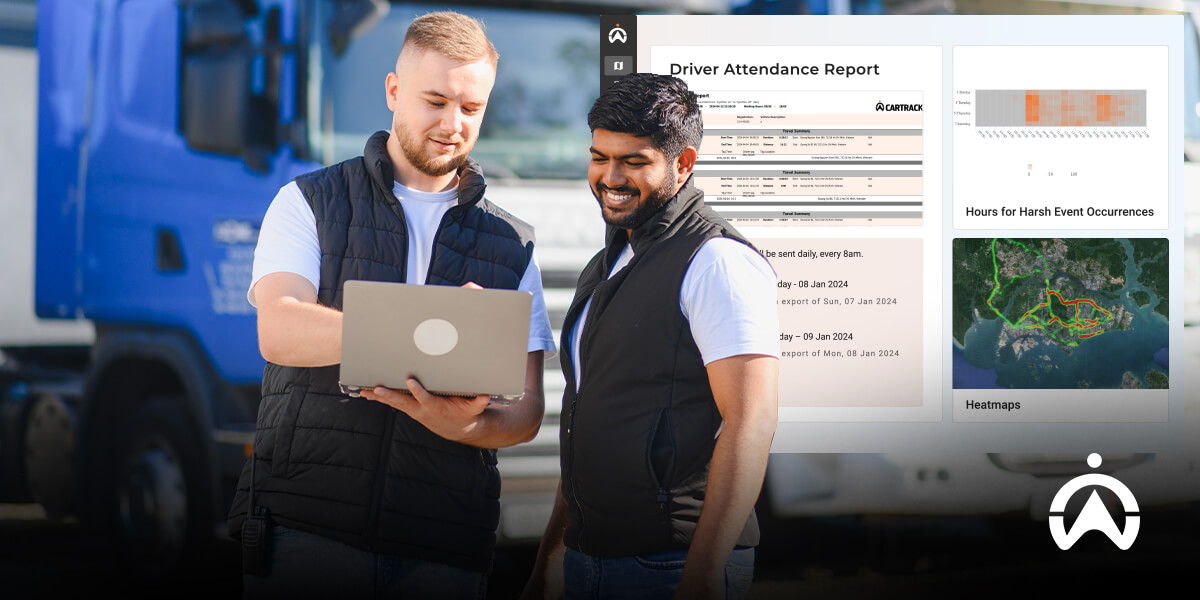
Data visibility: You have a complete overview of all the information you’d need on Cartrack’s FleetWeb platform. Every aspect of your fleet is covered, from fuel consumption and driver habits to maintenance. This makes it that much easier to spot those ever-elusive business gaps.
Custom reports and KPIs: FleetWeb has automated reports that you can customise to make reviews a simple task. You can gather whatever information you need without worrying about doing it all manually.
Driver behaviour analytics: We know how important safety is to your fleet productivity, which is why we have driver monitoring and scorecards on offer. You can coach the drivers needing help, reward those who are practising safe habits, and introduce incentives for all.
Simplified and automated information: Cartrack takes the hassle out of collecting data. Automation means you don’t have to spend hours looking over numbers, and you can quickly and confidently get to implementing the changes you need to raise productivity.
Final takeaway
Fleet benchmarking is the key to your business’ lasting success and constant improvement. The fleet industry is an ever-evolving one, meaning costs are constantly rising, customer demands are growing, and the need to have full visibility is weighing heavily.
Fleet benchmarking is how you can gain all the knowledge at hand and stop speculating about how your fleet compares. Cartrack can make this process that much simpler for you, providing accurate and automated data you can turn into a valuable business advantage.
Are you ready to benchmark smarter and consistently outperform?Book a demoand let us show you how your fleet really performs.
FAQs
How often should a fleet be benchmarked?
A fleet should be benchmarked at least once a year, although it can be every quarter if you’d prefer something more regular. This can also depend on how rapidly the market is growing. Regularly reviewing benchmarks keeps your data updated and your business goals in line with your plans for regular improvement.
Can small fleets also benefit from benchmarking?
Yes, small fleets can benefit from benchmarking. Growth and development aren’t reserved for bigger businesses, and smaller businesses can also make the most of their resources. Through benchmarking, smaller operations can cut costs, increase vehicle longevity, and improve driver performance, without needing a massive team or fancy infrastructure.
How do I know which fleet benchmarking metrics are most relevant for my business?
You can know which fleet benchmarking metrics are most relevant for your business by seeing which ones impact your profits the most. Driver habits and CPK (cost per kilometre) are examples of some key metrics. It ultimately depends on what you’ve defined as your core objectives.
How long does it take to see the results of fleet benchmarking?
It typically takes several months before you start seeing tangible results from fleet benchmarking, but you could even be seeing results in a few weeks. The results that reflect quickly are usually from metrics like driver coaching or fuel management.
Eliminate uncertainty in fleet performance. Discover key metrics, compare your fleet to industry standards, and use insights to make meaningful changes.