
Is your business properly measuring the greenhouse gases it’s responsible for? Carbon tracking relies on three specific scopes that have been set by the GHG Protocol:
The carbon tax increase in 2026 makes tracking emissions an immediate priority for fleet managers in South Africa. When a business treats their fleet’s carbon tracking as an afterthought, they often fail to realise that their fleet actually touches all three emission Scopes. Leaving notable compliance gaps and other hidden costs.
With a fleet management system from Cartrack, you can gain complete operational insights into your fleet. This helps you reduce your fleet’s carbon footprint and keep your business aligned with sustainability standards and compliance regulations.
Carbon tracking is the practice of measuring, categorising and reporting the greenhouse gas emissions that an organisation is both directly and indirectly responsible for. New laws and regulations make it compulsory for companies to track their emissions, and the 3 Scopes of carbon tracking help categorise them.
With road transport being responsible for roughly a quarter of all global transport emissions, fleets have to become more responsible for reducing their carbon footprint. There are three Scopes of carbon tracking that all businesses with a fleet need to know and understand.
Let’s take a detailed look at each scope.
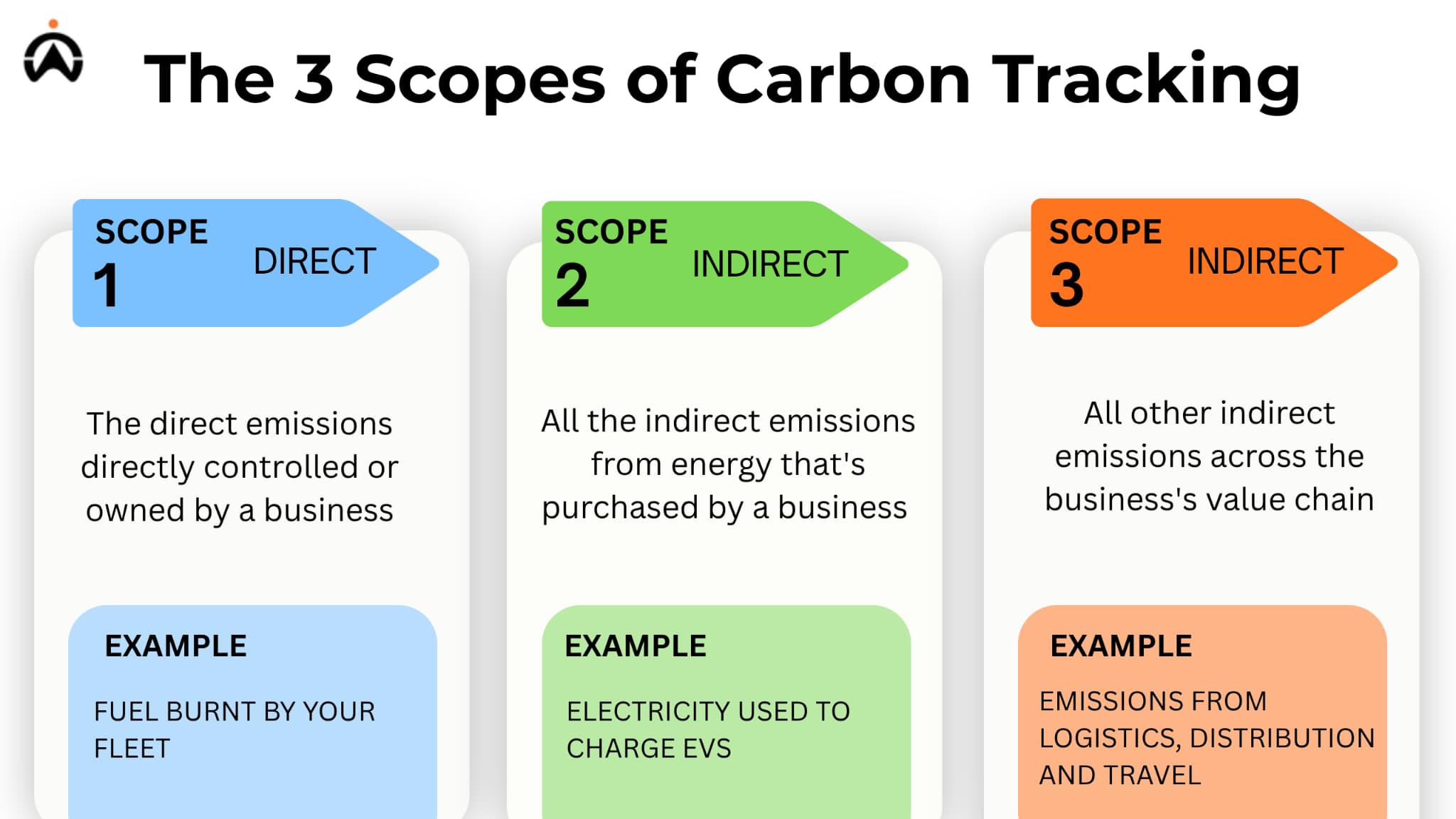
Scope 1 encompasses all the emissions directly controlled or owned by a business. For non-industrial businesses the main source of Scope 1 comes from the fuel their fleet burns.
In South Africa this Scope comes with immediate financial consequences thanks to the carbon tax and the carbon-linked fuel levy. For fleets, this not only makes Scope 1 a sustainability metric but a financial one as well.
All indirect emissions from energy that a business buys fall under Scope 2. This scope was never used to be a trackable emission for fleets. However, with more fleets buying electric vehicles, Scope 2 will now need to be tracked from the standpoint of charging these vehicles.
Scope 3 is for all the other indirect emissions that a business is responsible for, such as:
Scope 3 is also known as the most difficult scope to measure, as well as being the largest one. In 2024 a report by CDP and Boston Consulting Group stated that Scope 3 emissions run, on average, around 26 times higher than a company's combined Scope 1 and Scope 2 operational emissions.
But only 15% of CDP-disclosing corporations had actually set a Scope 3 reduction target!
A lot of Scope 3 emissions come from logistics, distribution and travel, meaning your fleets are largely responsible for this.

Business owners often treat these scopes as three different data-collection tasks that have to be checked off a compliance checkbox. Fleets, however, don’t work in the same way as the rest of your business. With the right tools in place, you can gain comprehensive fleet data including:
All this data that’s already generated for costs and safety measures can all be used for:
There are two pieces of EU policy that are worth knowing: The Corporate Sustainability Reporting Directive and The Carbon Border Adjustment Mechanism. For any fleets trading or thinking of trading into Europe, it’s important to understand their carbon tracking regulations.
The CSRD had a major simplification this year. Following the EU’s Omnibus package, mandatory social and environmental reporting now applies to companies that have more than 1,000 employees and over €450 million in turnover.
All non-EU parent groups with more than €450 million in EU turnover are also pulled into this scope, but not until the 2028 financial year.
CBAM, however, has started its definitive and cost-bearing phase since the 1st of January 2026, and it applies regardless of a company’s size. All exporters of goods into the EU have to supply verified and embedded-emissions data to their EU customers. The exported goods include:
Any South African exporters of these goods can offset some of that cost against the local carbon tax; however, the data requirement itself isn’t optional.
Regardless of whether a supplier is legally required to report anything, many large international buyers are incorporating Scope 1-3 emissions data into procurement as a condition of working with them.
So, even if a business is sitting outside of the CSRD’s narrowed scope, it can still receive a supplier inquiry from a major customer requesting the exact emissions data the CSRD would have required.
South Africa’s carbon tax phase 2 is officially in effect. For fleet owners, it’s imperative that you understand what this means for you and why it shouldn’t be something that either your finance or sustainability departments look at once a year.
The carbon tax jumped 31% from R236 to R308 per tonne of CO₂e on 1 January 2026. This is notably the biggest jump since this tax was introduced in 2019, and the National Treasury has stated that it’s set to climb to R462 per tonne by 2030.
Phase 2 of the carbon tax has also started eliminating the substantial tax-free allowances which have in the past kept a lot of businesses' effective carbon costs notably below the headline rate. For operations that have a large fleet, this combination of higher rates and smaller allowances is closing the gap between your fuel bill and your overall carbon tax exposure.
Unfortunately for fleets, there’s a second and less predictable pressure that’s sitting comfortably next to the tax increase: the price of fuel. In 2026 alone, the price of diesel has jumped 8 times. Starting the year at around R18.52 to R31.38 in May and then R26.90 in August.
These constant fluctuations in fuel prices affect how much fleets are spending and can put them out by hundreds of thousands of rands. And it’s completely out of their control.
This is where Scope 1 tracking changes from simply being about sustainability reporting to being more about a fleet’s basic financial visibility. The same data you're gathering on vehicle fuel usage for carbon tracking is the exact same data that’s showing you where fuel is being wasted.
To start accurately tracking your fleet’s carbon footprint across all three Scopes, you're going to need a fleet management provider like Cartrack. You need one platform that can give you complete operational insight and allow you to effortlessly track your entire fleet and its carbon footprint.
Here are the 3 steps you can follow to start tracking your fleet’s carbon footprint across all three emission Scopes.
Your first step is to make sure you're getting accurate fuel usage and distance data per vehicle. Not a fleet-wide average or fuel card totals. Having only the averages will hide the anomalies, such as routes, vehicles, and driving patterns that are burning fuel more excessively.
Cartrack’s CO₂ reporting runs on a clear hierarchy for every vehicle in your fleet. Here’s how we do it 👇
And our report will show exactly which of the three was used. This traceability allows organisations to turn a carbon number into a credible and measurable one instead of an annual estimate.
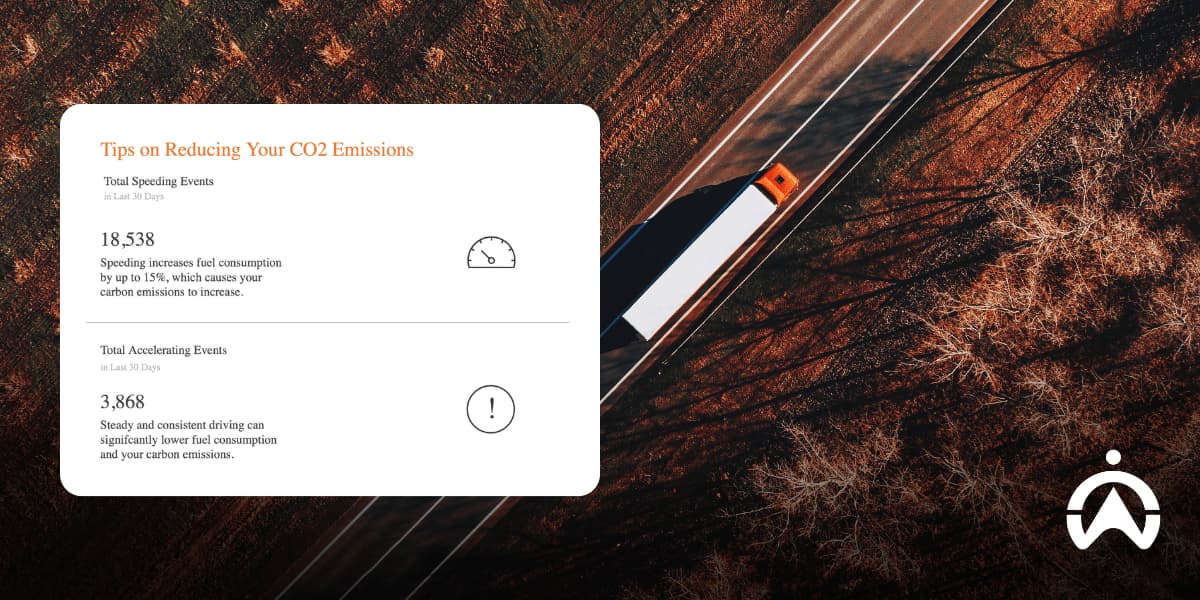
If you’ve started adding electric vehicles to your fleet, set up charging sessions and depot energy tracking before the EVs make up a huge portion of your fleet. This will make it easier on you in the long run, because it’s much easier to integrate this with a few vehicles than to recreate a year’s worth of charging data once you expand your electric fleet.
When done correctly, you should treat electricity like fuel and use battery data when available and convert it into CO₂ emissions with its specific emission factor, instead of assuming it’s zero. This is exactly why an electrified fleet shouldn’t assume its Scope 2 emissions will automatically appear “clean”.
Accurate route and distance data align quite closely with Scope 3 distribution and logistics categories. Trip-purpose data can help to differentiate between actual business travel and personal commuting, which are both recognised in Scope 3 categories.
While this won’t give you a complete Scope 3 inventory on its own. It’ll still provide businesses with a solid, data-driven starting point for tackling the most challenging scope to measure.
Throughout all of the steps, you can see that none of them required three separate systems. It’s simply the same fleet data being structured to answer three different questions.
The businesses that are truly going to thrive are the ones who aren’t waiting for a law to force them to be better. It’s the companies who are investing in fleet data that’ll help keep them evergreen and avoid the inevitable carbon tax bill.
Cartrack’s fleet management system gives you data on:
If you’re ready to make sure your fleet is sustainable, then give us a call and let Cartrack be your carbon tracking partner!
Scopes of carbon tracking explained for fleet operators and the global rules, local carbon tax changes, and data every fleet manager needs to track in 2026