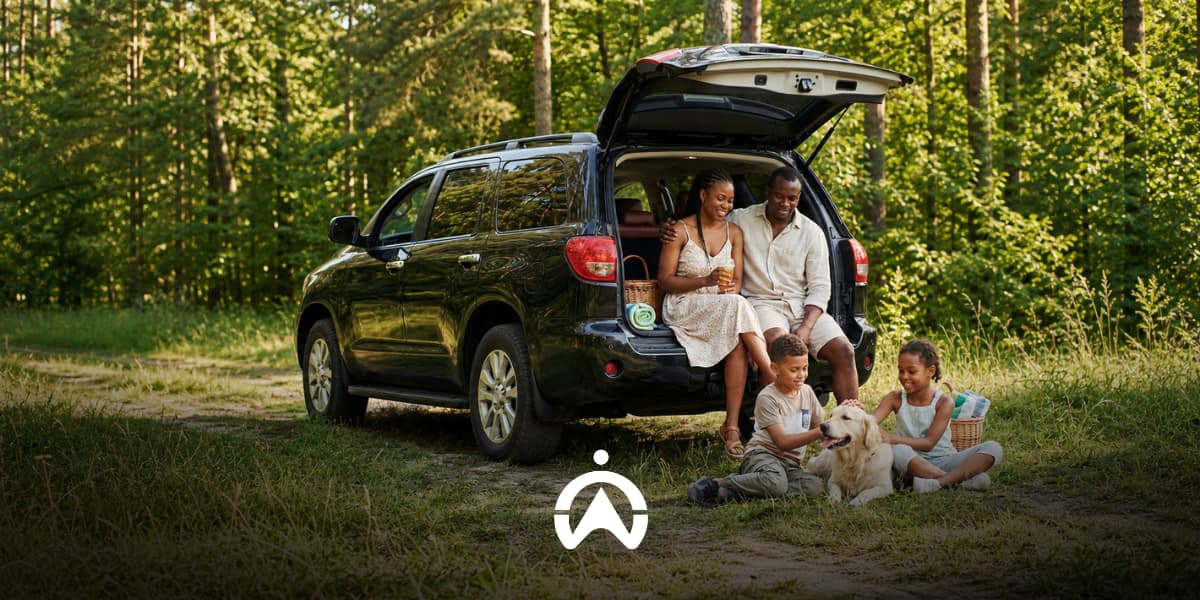
The car size you should buy for your family depends on how many members there are and how much storage space you need on a daily basis. Most agree that compact sedans and SUVs are ideal for small families, midsized SUVs and crossovers are ideal for medium-sized families, and minivan-styled cars are ideal for larger families.
To find out more about family cars and travel safety, take a look at our responses to these FAQs!
The safety features you should look for when choosing a family car include:
The vehicle size that’s best for a small family is usually a small-to-midsized SUV or a compact crossover, but it ultimately depends on your context (budget, boot space needs, etc.). Crossovers are usually a little lighter in weight and drive more smoothly than SUVs. Otherwise, both car types have great boot and passenger space, safety features, and a level of affordability.
A hybrid is the best choice for long-distance family driving. It’s the perfect option if you’re unsure about going fully electric, but it also gives you options while you’re on the road for those family trips. You don’t have to plan or stop for charging breaks, and you can still save on fuel in the end.
According to research, a reliable family car should have at least six airbags. Six is the standard number of airbags in most modern, semi-premium cars, although a higher number of well-placed airbags are always preferred. Some cars provide up to ten airbags, protecting areas like your head and knees.
A family of five should step up to a 7-seater. A choice like this is all dependent on your finances, but comfort and convenience are major factors to think about. Choosing an exact 5-seater becomes a bit of a squeeze, especially if you have car seats or taller kids who need their space. Opting for a 7-seater gives everyone enough breathing room.
To keep your kids safe in a family car, you should:
Cartrack protects your family and your vehicle by offering these advanced safety measures:
If your car is hijacked with your kids in it, you should react calmly but swiftly. Don’t antagonise the thieves, always keep your hands visible, and keep your voice low & calm while announcing that you’ll get your children out of the car. Otherwise, immediately contact your car tracking provider and the police, giving them as much info as possible.
Yes, dashcams are effective at keeping your family safe. They capture critical evidence in an incident and carry so much weight during he-said-she-said moments involving your family. They might not stop an incident from happening, but they’ll clearly (and objectively) prove the facts.
Good cars for first-time moms are modern, compact SUVs and hatchbacks. Many of these cars give you the space needed to comfortably fit the baby’s car seat while also providing enough boot space for your baby’s essentials. These cars are usually easily manoeuvrable, kitted out with modern safety features, and easy to drive.
You safely secure a newborn in a car by placing them in their car seat. The car seat should be in the backseat and securely fitted facing rearward; this ensures that your baby is snug and safe. Make sure the handlebar is in an upright position. Click the harness in and ensure it’s tight enough. Recline the seat to about 45 degrees.
Yes, you can monitor your child’s driving behaviour using the Cartrack app. Our mobile app gives you a breakdown of how a driver’s been behaving on the roads, showing when and where they drove aggressively, i.e., took a corner harshly, accelerated too fast, etc. If you have a Cartrack GPS tracker in your child’s car, you’ll be able to see those details.