
To calculate your fleet electrification ROI for your business, you should take the cost of investing in electric vehicles (EVs), compare it with the savings they’ve generated and weigh that against fuel and maintenance costs. To increase your business savings, you should invest in a powerful fleet management system.
The right software will give you space to completely transform your fleet strategy and save across areas like fuel, maintenance and driver habits (which affect fuel and energy costs).
Making the electrification switch can be daunting, especially when almost every fleet manager ends up asking the same question: Will it pay off? Working out the ROI isn’t the hard part, but knowing which data you need to use can be. Keep reading to calculate fleet electrification ROI, grow your business savings and find out how Cartrack can support you in achieving both.
To calculate fleet electrification ROI, you compare the costs of the EV (the process of electrification and the savings over some time) and then divide the net gain by the cost. As a formula, this is written as:
Fleet electrification ROI (%) = [(Total financial benefits − Total electrification costs) ÷ Total electrification costs] × 100
Let’s break down what each of these parts means:
This is a simple prediction equation, although the more accurate your numbers are, the better your results will be.
A practical example: Five steps to calculating ROI
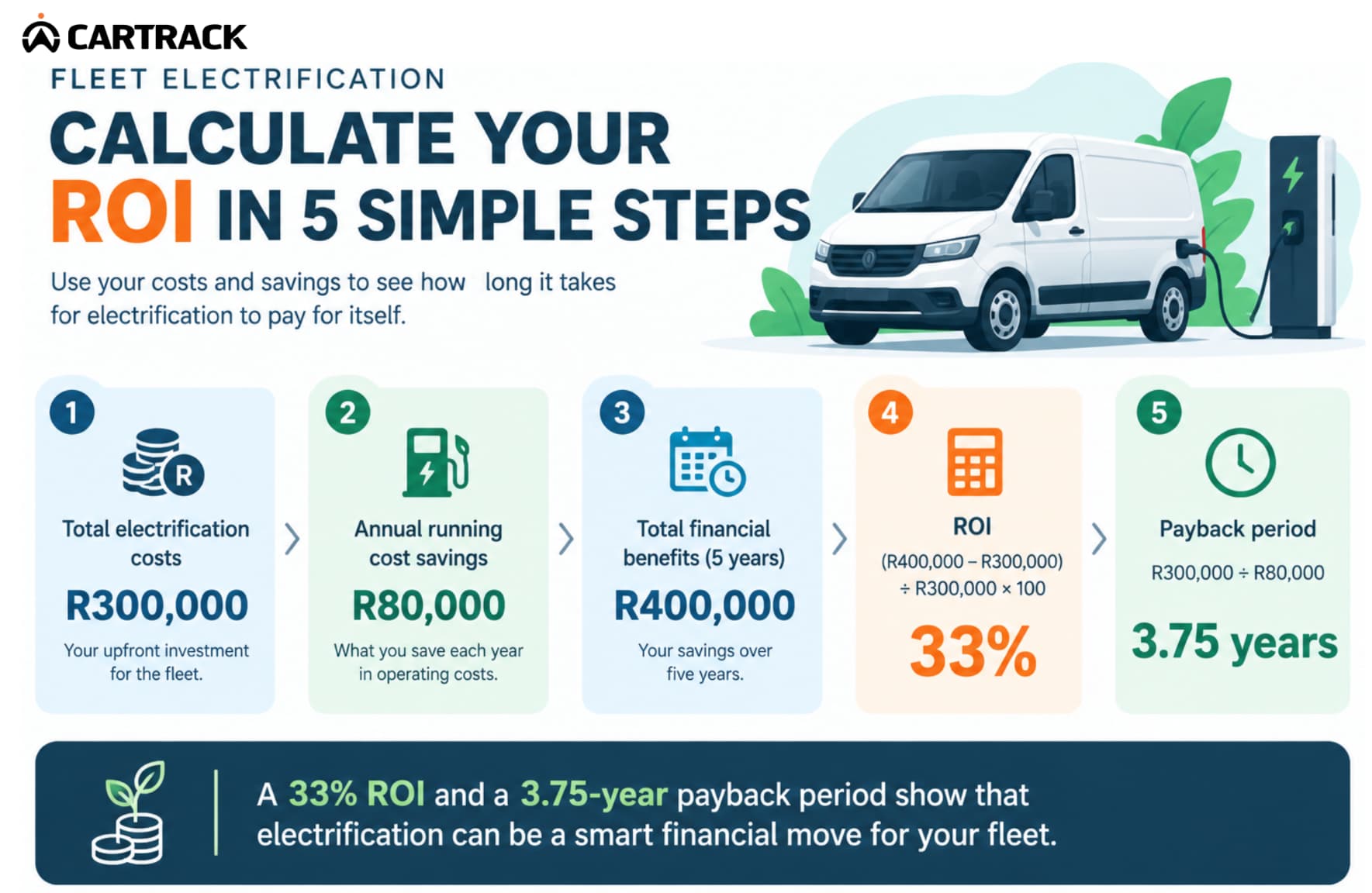
💡 NOTE: A payback period indicates how long it’ll take to break even and tells you roughly when you’ll get your money back from this investment. So once you’ve reached the payback period, everything after that is net savings.
The operating costs that go into your total cost of ownership (TCO) are essentially all the costs. From purchase costs and insurance to maintenance and energy, everything that you pay to buy, run and eventually sell the vehicle makes up TCO.
To compare EVs with your current fleet fairly, work out both using the same categories in the table below. These are the core costs needed to effectively calculate an ROI estimate.
Take a look at the table:
Your fleet vehicles have no single ROI figure because it’s based on how the vehicle runs, and is not just a simple fuel-powered vehicle versus EV comparison. This means it’s likely that no two vehicles in your fleet will have the same ROI figures, and that’s why settling on one ROI percentage for the whole fleet is misleading.
South African data reflects this.
According to Clean Technica, electric commercial fleet operators have shown a 27% cost benefit improvement. The article goes on to state that a one-tonne EV starts costing the same as its diesel counterpart once it drives about 3,200 km a month, with the savings continuing to grow as the vehicle drives more. But for four-tonne and eight-tonne EVs, that point is about 2,500 km a month.
Charging patterns also play a role here. The first ten electric trucks from Takealot Fulfillment Solutions' averaged about 14% less in costs than their diesel counterparts when charged from a grid. That number climbed to 27% when charging energy was supplied by solar power.
The key is having the RIGHT USAGE DATA. Travel history, idling, charging bases and more; this is the kind of information that turns estimations into authentic, factual data that can inform a more reasonable ROI figure.
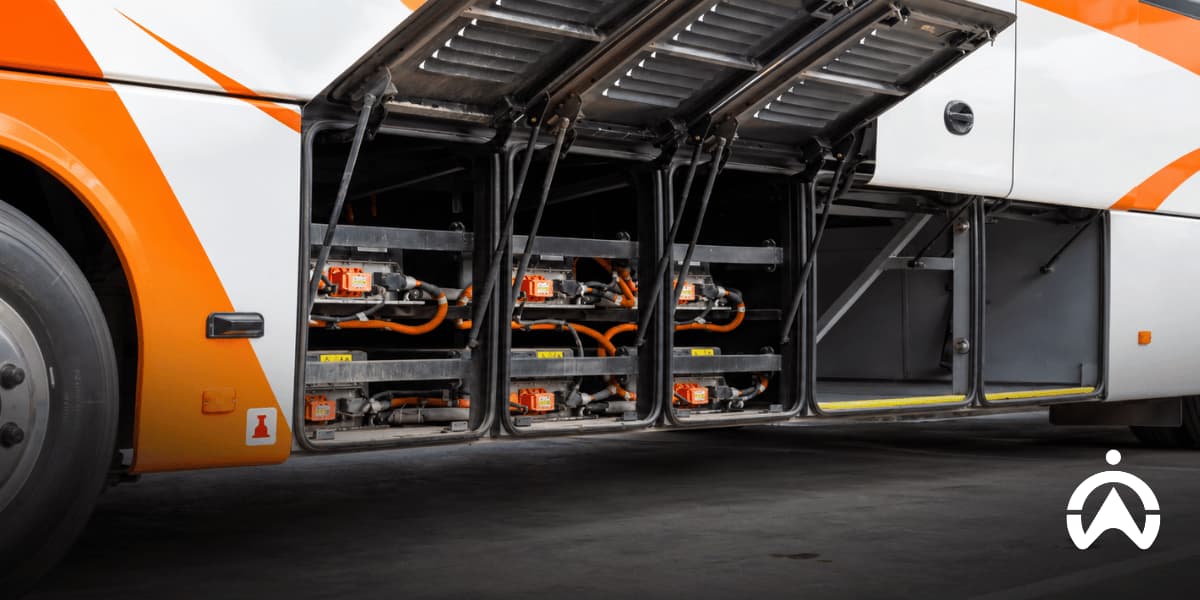
You increase savings on charging infrastructure, energy and maintenance costs in your electrified fleet by adapting to smarter operations with the help of a fleet management system. Smarter operations mean planning & optimising routes, coaching drivers, charging more effectively and using your own energy for charging.
Let’s break it down:
✅ Planning and optimising routes: Range anxiety is very much a concern; having a better understanding & overview of your vehicle’s battery status as well as optimised routes helps with that. When linked with telematics, you can see how the EV is performing in relation to its charge point times as well as how to take the best routes for effective range management.
✅ Coaching drivers: How your drivers behave on the roads directly impacts how much energy is used up, and this applies to both ICE vehicles and EVs. Drivers who are exhibiting reckless on-road behaviours will likely use more electricity from the EV, meaning the car needs to be charged more often. The only difference is EVs have regenerative braking, which can help regain some energy.
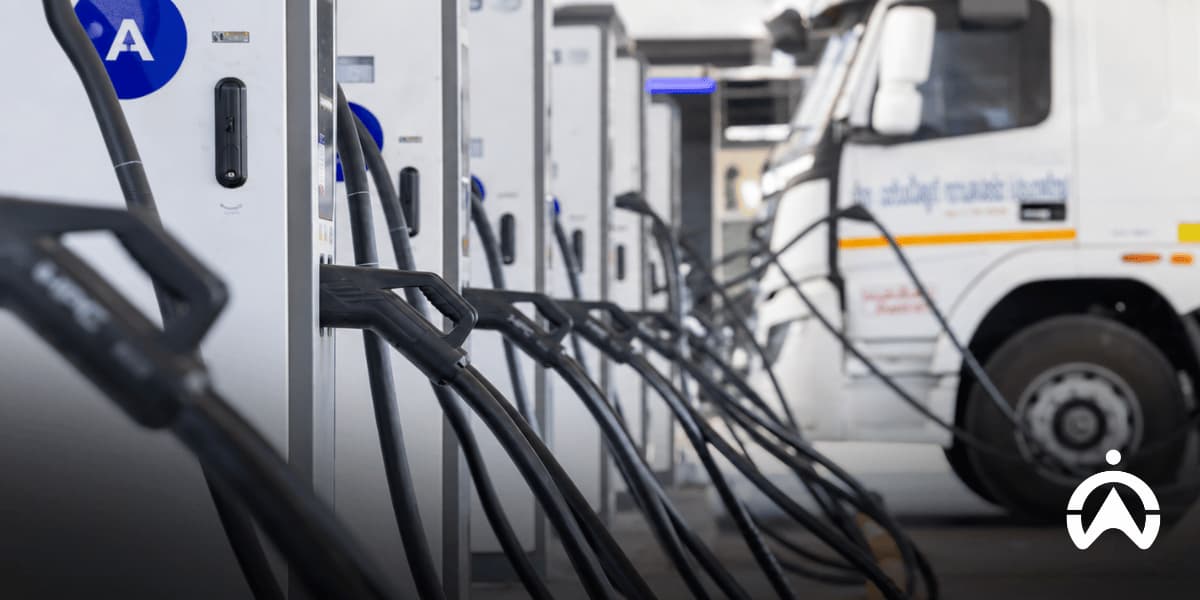
✅ Charging more efficiently: Aiming to charge your EVs during off-peak times (when using public stations) or on your own site can help you increase those business savings. Charging infrastructure can be another hefty expense that’s part of your electrification strategy, but in the long run, it usually ends up being far cheaper than charging publicly.
✅ Using your own energy for charging: Having your own infrastructure could be massively worthwhile for your electricity bill. To add to that, adopting solar power for your charging stations can further reduce your charging expenses. When you rely on less energy from outside, you also have a more predictable charging-cost budget.
All of the above points rely on the same thing: knowing when your vehicles charge, how they're driven and where they go.
Cartrack’s fleet software helps you measure and prove your electrification ROI by providing you with the accurate insights behind every single fleet vehicle. You get the exact figures behind factors like travel time, battery performance, how it’s driven and so on. With this data, you can move away from broad estimates and towards figures you can defend.
Here’s the problem: no data = not having an idea of your ROI. You’re completely blind to which vehicles are helping you save and which are costing you more than you think.
Here’s how this works in practice:
EVme is Thailand’s first and only rental and purchase service provider, operating a fleet with over two thousand different vehicles. Before partnering with us, EVme had extremely limited insight into how the vehicles were being operated and where they were going. This made it hard to keep track of reliable and necessary data like mileage, maintenance, energy consumption and trip histories.
Once EVme adopted Cartrack’s platform, FleetWeb, they were able to track their vehicles, monitor battery statuses and see how their EVs were being operated by the drivers. The results they received weren’t ROI figures on their own, but each part of the results protected parts of the ultimate equation.
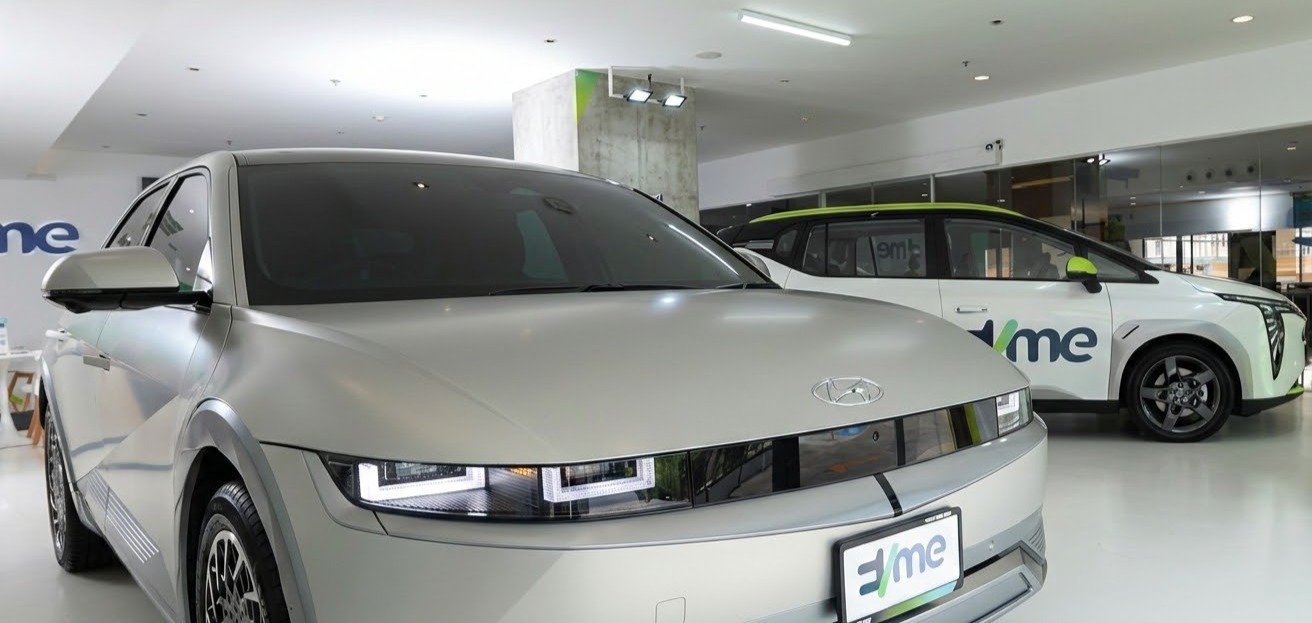
EVs have much higher initial costs, so every vehicle that’s used inappropriately can really cost you. Business impact reports show that EVme saw a 100% reduction in unauthorised vehicle use and theft prevention. Vehicles are also only as good as their utilisation, so route planning and battery info played a major role here.
The report also demonstrated a 99% improvement in on-time vehicle delivery and ultimately a 98% increase in customer satisfaction. For your ROI, that matters because it protects the money your vehicles earn, not just the money you save.
“Cartrack has made managing our vehicles…significantly more efficient and transparent." EVme's Head of Fleet Management and Acting Chief Operation Officer Akradech Chetchutithorn said.
All of this points towards the necessary information and real numbers you need for your ROI formula. Let’s look more closely at how Cartrack brings this all together for your business.
Cartrack’s fleet software can offer you EV trip summary reports in the form of energy consumption analytics, battery & charging statuses, trip histories and predictive maintenance. It can also help you monitor driver behaviour.
Let’s break down each of these solutions:
🟢 KEY BONUS: Cartrack’s fleet system covers both EVs and your current fuel vehicles, so if you have (or plan to have) a mixed fleet, you can see both sides of your ROI comparison in one place.
A lucrative electrification strategy is only as good as the numbers you put into it, and we know now that it can look different from vehicle to vehicle. The EVs that are used often, used well and remain well-maintained are the ones that are bound to really pay off.
Electrification is a process that’s done best when it’s done gradually and backed by data. Start by measuring how your current vehicles are used, electrify the ones that make sense, then keep tracking the vehicles so you can prove (and see) the tangible savings.
See what your own fleet data REALLY says. Speak to a Cartrack fleet expert to find out how Cartrack can help you measure your electrification ROI and transform your fleet strategy.
Calculate your EV transition payback. Discover how to accurately estimate fleet electrification ROI and maximise long-term cost reductions.