Are electric vehicles actually safer, and are you less likely to have an accident in one? Yes. Advanced tech like Advanced Driver Assistance Systems (ADAS) do help in preventing accidents, and their build is designed to make them more stable on the road. But human error is still the main cause of accidents, regardless of what powers your car.
Driver behaviour is the number one cause of road accidents, with over 87% of accidents in South Africa in 2025 being caused by human factors.
Many people move from fuel-powered vehicles to electric vehicles for the benefits. The main benefit is saving on fuel costs, but because of the technology built into the vehicle, many people think that they are safer as well. But does this technology mean that fleets with EVs have fewer accidents?
Electric cars are considerably safer compared to their ICEV counterparts. This is specifically because of how they're built. The heavy batteries are placed along the floor of these vehicles, which means they're less likely to roll over. The front of the vehicle that doesn’t have a bulky traditional engine allows a bigger crumple zone.
Remember, no vehicle will ever be risk-free. EVs still have to perform the same crash safety test as ICE vehicles, with an additional test for the battery.
Guy Carpenter put together data from 2020 to 2023 from the Norwegian Public Roads Administration (NRPA). They examined over 2 million registered EVs and came to the conclusion that “EVs experience a significant reduction in the frequency of accidents per kilometre driven compared to ICEVs.”
There are features in EVs that are there to help prevent an accident. There are also specific design characteristics to make them more stable on the road. Advanced driver safety technology (ADAS), the way electric vehicles are built and designed and how these features affect driver behaviour are the main reasons that EVs could have fewer accidents.
Advanced Driver Assistance Systems isn’t something new, but it’s also not something every vehicle type comes equipped with. A lot of modern EVs however, do come with ADAS built into them.
ADAS includes features like:
These features not only keep the driver informed and alerted at all times, but they also help them to react in time to prevent an accident.
*Remember that ADAS isn’t exclusive to newer EVs; a lot of new ICEVs also have built-in ADAS with some of these features as well.
EVs use regenerative braking to recover energy when they're slowing down. So when a driver takes their foot off the accelerator, the motor will act like a generator and convert some of the kinetic energy into electricity.
Because the driver will slow down without completely relying on the brakes, and it encourages drivers to decelerate smoother, your driver is creating a safer driving habit.
Electric vehicles are extremely quiet, have immediate torque, have advanced digital displays, and have a lower and more centralised centre of gravity.
The heavy batteries that an EV runs off are placed at the bottom of the vehicle. And because of this, their centre of gravity is lower and centralised so EVs have:
Immediate torque and having a quieter drive can reduce fatigue and create a more comfortable drive.
Advanced digital displays that are common in EVs provide drivers with immediate valuable insights such as:
EVs may have fewer accidents, but they still crash. They just do it differently and sometimes for completely separate reasons compared to fuel-powered vehicles. EVs operate and are built differently, and because of this, drivers need to adjust their driving habits.
The Marsh Re (formerly Guy Carpenter) study confirmed that EVs experience 36% fewer accidents per kilometre overall. The risk varies significantly by vehicle age: new EVs (0–2 years old) actually record a higher crash frequency than petrol or diesel vehicles as drivers adapt to instant torque and automated lane-keeping before dropping to the lowest accident rate of any vehicle class by the 6–10 year mark.
This proves that driver training is particularly important for fleets that adopt EVs.
The same study also stated that EV accidents were 8% more severe compared to ICEV’s. And this is because of their build. The heavy batteries that are placed in the vehicle make them significantly heavier in an accident as well, so when they're involved in an accident, it’s much more extreme.
Driver behaviour is the number one cause of road accidents, with over 87% of accidents in South Africa in 2025 being caused by human factors. So while electric vehicles have built-in safety features like lane assist, a driver that’s not used to this feature can actually cause an accident.
For example, lane assist will keep you in the lane your driving in. However, when you move into another lane but don’t put your indicator on, the car assumes you're swerving, and it will pull the vehicle back into the lane you're trying to leave.
For a new EV driver that doesn’t know this, they're likely to panic when this happens and end up causing an accident trying to fight the car that’s forcefully pulling it back into the lane. This is the same with the immediate torque. If your driver isn’t used to this, they can end up rear-ending another vehicle or slamming on the brakes, causing another vehicle to hit them.
EV adoption is growing, but charging infrastructure is still catching up in a lot of areas, especially in rural spaces. Long-haul fleets are more likely to have a mix of vehicles because of this. They’ll have their EVs doing the local jobs and their diesel trucks doing the trips across the country.
And because your EVs are constantly travelling through built-up cities with bumper-to-bumper traffic, they're more exposed to accident-prone situations.
Silent vehicles are a hazard to those around them. Particularly pedestrians. Someone standing behind an electric truck that starts reversing is likely to be unaware of the danger they're in until it’s too late.
In the analysis done by Guy Carpenter, “EV accidents involve 32% more parties on average than petrol accidents and are twice as likely to involve a pedestrian”.
For South African fleets, this is a particular problem. According to the Road Traffic Management Corporation’s (RTMC) 2025 State of Road Safety Report, 5,224 pedestrian deaths were recorded. Drivers of EVs need to make sure that they're extra careful around areas with heavy foot traffic in SA to ensure they're not a bigger risk to pedestrians.
In the same study, they found that collision costs for EVs are 21.9% higher compared to ICEVs. So while electric vehicles may have fewer accidents, when they are, it’s much more expensive. Additionally, according to research done by Lero, the Research Ireland Centre for Software, EV repairs are 6.7% more expensive compared to traditional ICEV.
Telematics helps make EV fleets safer because they provide data that fleet managers can actually act on. Remember, even with all the safety features built into EVs, they don’t automatically make your fleet safer. The advanced safety features still can’t eliminate:
These are things that still need to be monitored and corrected.
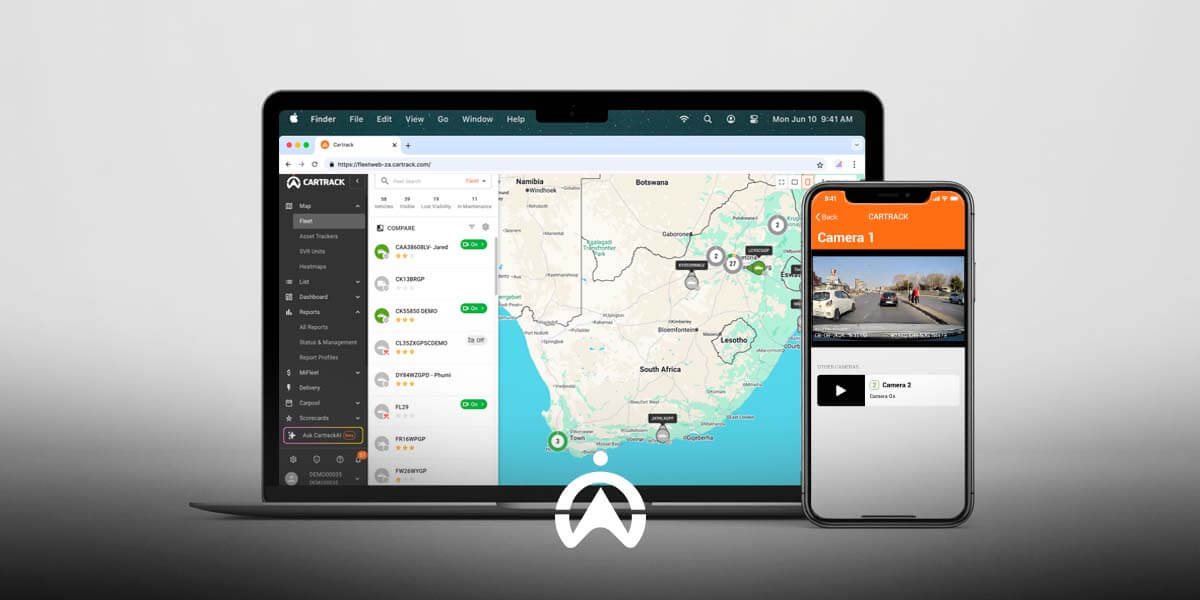
Cartrack has an advanced fleet management system that can help make your fleet safer. Regardless if your fleet is electric, fuel-powered or mixed. You can monitor them all on one platform.
Telematics won’t automatically prevent accidents in your EV fleets either. But, combined with the safety features in an EV, you can build a safer fleet that’s less prone to causing an accident.
EVme is Thailand’s first and only 100% EV rental and purchase service provider, with a fleet of over 2,000 vehicles across multiple leading brands and models. EVme implemented Cartrack’s fleet management system, including CAN-Bus integration, delivery management features for vehicle pickups and returns, and API connectivity for seamless data exchange.
“Cartrack has made managing our vehicles through the EVme application significantly more efficient and transparent. With real-time vehicle tracking, accurate pickup and return scheduling, we have reduced the risk of vehicle loss. The driving behaviour monitoring system also helps us address risky patterns early and prevent further damage to our EVs. Cartrack aligns well with our sustainability goals in supporting a more efficient and long-term EV experience for our customers." - Akradech Chetchutithorn, Head of Fleet Management / Acting Chief Operation Officer for EVme
To actually measure if your electric fleet is safer, you can build a comparison table between your ICEVs and your EVs. However, to make sure that you're getting an accurate result, compare similar vehicles, routes, operating hours, and driver experience.
Measure the following metrics for each vehicle:
What we can clearly see from the data is that electric vehicles change the way a fleet operates, but it doesn’t replace the need for proactive safety fleet management. While EVs can improve safety on the road, drivers still need to be coached to make better and safer driving habits.
If you have an electric fleet, an ICE fleet or even a mixed one, Cartrack’s fleet management solution can help improve the safety in your fleet by giving the drivers and fleet mangers the insights that they need.
Click here to request a demo or to speak to an agent today!

Find out if having an electric vehicle fleet is safer and if you’ll have fewer accidents.